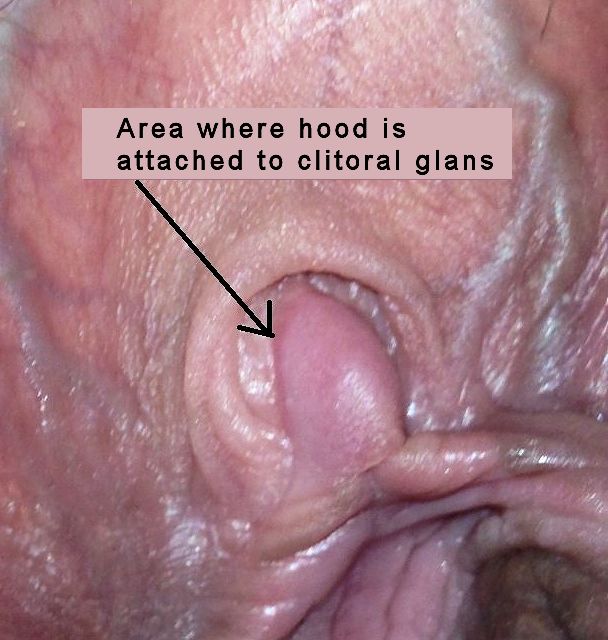
Clitoral adhesions are present when the clitoral hood is adherent (stuck) to the clitoral glans, which prevents full retraction of the hood.
Clitoral adhesions are common, and the medical literature presents conflicting information as to whether they are directly related to female sexual dissatisfaction, except in cases of clitoral pain.
The majority of adhesions affecting women of reproductive age have more than likely existed since birth, unless there is a history of chronic irritation, such as lichen sclerosus.
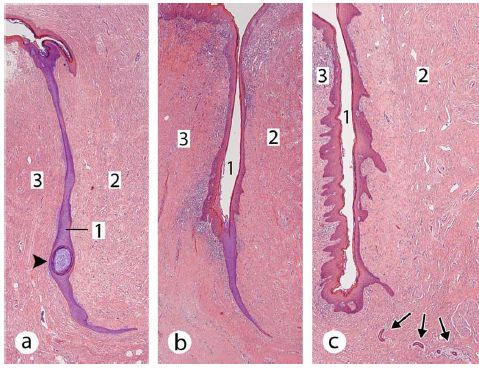
At birth and during early childhood, the clitoral hood is normally adherent to the clitoral glans, and should not be forcibly retracted.
During childhood and puberty the adhesions typically resolve, most likely as a result of hormonal changes.
If the skin of the hood and clitoral glans become irritated or injured, the two surfaces may heal together, forming new adhesions.
In adult women, it is believed new adhesions form as a result of blunt injuries to the clitoris, and irritation caused by fungal or bacterial infection.
If the hood cannot be sufficiently retracted, the clitoral glans cannot be directly or indirectly stimulated, which may impair sexual function.
When the hood cannot be fully retracted, it is called clitoral phimosis.
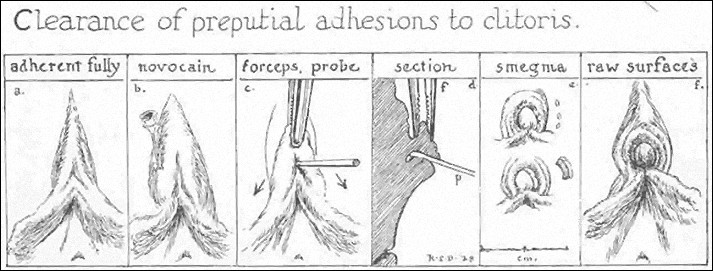
Clitoral adhesions can be treated by application of estradiol cream, or surgically.

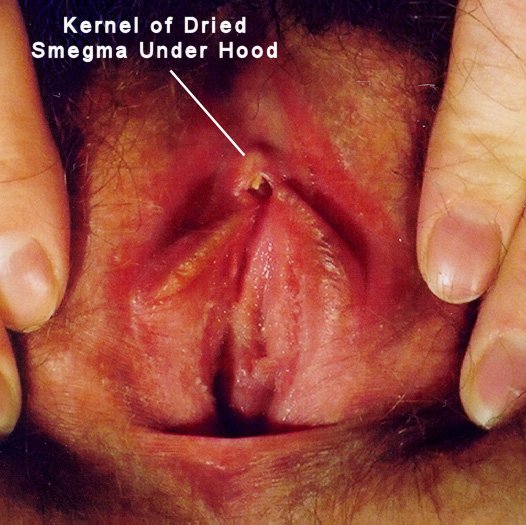
An adherent hood may trap normal sebum production, resulting in the formation of smegma.
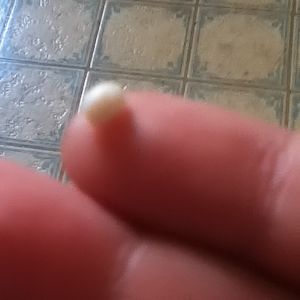

Dried kernels of smegma may irritate the clitoral glans, resulting in pain during daily activities, including sex.
On examination, 1 out of 3 college-age-women were found to have clitoral adhesions, with few or no related medical complaints.
Nineteen-percent of the young women had adhesions affecting 25% of the clitoral glans, and 4% had adhesions affecting more than 75% of the glans.
Many college-age-women have not experienced sex with a partner or masturbation, are sexually inexperienced, and may not be aware of impaired sexual function, or are too embarrassed to discuss sexual concerns.
Medical Article Quote:
"Clitoral phimosis results when the skin of the prepuce or clitoral hood loses
elasticity from chronic infection or skin disorders such as lichen sclerosis.
Mild clitoral phimosis exists if the fibrotic prepucial skin cannot retract
fully and covers at least 50% of the glans clitoris; most such cases are
asymptomatic, and may be managed with topical estradiol cream. Clitoral phimosis
may be considered as moderate or severe if the fibrotic prepucial skin covers
75% or 95% of the glans clitoris, respectively. Such patients may have symptoms
of itchiness, tenderness, and discomfort of the clitoral region with
underlying erythema [abnormal redness], drainage, foreign bodies, and balanitis
[inflammation of clitoral glans] due to the closed compartment
syndrome."
Source: Surgical
Techniques: Dorsal Slit Surgery for Clitoral Phimosis
Twenty-two percent (1 out of 5) women treated for sexual dysfunction were found to have clitoral adhesions, and trapped smegma.
It is unknown, based on very limit research, if there is a link between clitoral adhesions and sexual dysfunction, except when dried smegma results in clitoral pain.
A small amount of adhesion, as in the top photograph, is not believed to impair sexual function, as the majority of the glans can be stimulated, directly or indirectly by movement of the hood.
Given that approximately 90% of women can experience orgasm, and 30% likely have some degree adhesion, in most cases adhesions do not impair a woman's ability to experience orgasm.
Medical Article Quote:
"Phimosis of the clitoris is often problematic because smegma can accumulate in
the space between the clitoris and prepuce that can cause a smegmatic
pseudocyst. These pseudocysts can become inflamed or infected. In addition,
clitoral phimosis frequently causes loss of clitoral sensitivity, which may
cause secondary anorgasmia."
Source: Surgical
treatment of clitoral phimosis caused by lichen sclerosus
References:
A Novel Approach to the Surgical Management of Clitoral Phimosis (PDF)
Anatomy and Histology of the Penile and Clitoral Prepuce in Primates (PDF)
The Prepuce (PDF)
Surgical Techniques: Dorsal Slit Surgery for Clitoral Phimosis
Surgical Treatment of Clitoral Phimosis Caused by Lichen Sclerosus (PDF)
Related Questions and Answers:
My doctor says I have a tight clitoral hood, what should I do?
What is this white bump on my daughter's clitoris?
Trying to overcome anorgasmia (absence of orgasm)
Injury to glans clitoris resulting in loss of sensitivity and arousal - Part 1 of 5
Related Articles On This Website:
The Impact of Clitoral Adhesions on Female Sexual Pleasure and Health (Original article)
Websites:
Published January 12, 2015